Presentations that don't just inform – but enable decisions.
CAai turns an initial idea, a few keywords or existing material into a coherent, audience-focused business presentation: with a clear business case, a convincing storyline, well-founded arguments, slide texts, visualization suggestions, speaker notes and Q&A preparation.
Communication Architect AI
The problem is rarely the slide. The problem is the unresolved argumentation.
In many companies, presentations are created under time pressure: content is gathered, slides are copied, charts are added – but the decisive questions remain open. What should the presentation trigger? Which question must the audience be able to answer? Which arguments matter from their point of view? Where is there consensus – and where are objections likely? When this clarification is missing, presentations show a lot but achieve little. They are complete, but not focused. Informative, but not decision-ready. Professionally designed, but argumentatively weak.
- Unclear direction
- The presentation explains a topic, but it does not lead to a concrete decision, action or insight.
- Too little audience perspective
- The arguments follow the sender's logic – not the interests, priorities, responsibilities and objections of the decision-makers.
- Too much detail, too little story
- Information is strung together instead of being condensed into a coherent line of argument.
- Typical wrong turn: fragmented slides versus the earlier approach taken by CAai
CAai starts where good presentations really begin: before the first slide.
CAai guides you through the proven storyboard approach and supports every step with a specialized AI and methodology engine. The app clarifies the business case, analyzes the sender and audience perspective, identifies areas of consensus and conflict and proposes the right argumentation. From this emerge the intro, core message, storyline, arguments, slide texts, visualization suggestions, speaker notes and Q&A preparation.
- Relevant
- CAai clarifies what the business case is really about – and what matters most to the audience.
- Convincing
- CAai develops an argumentation that fits the topic, the goal, the audience perspective and the potential for conflict.
- Effective
- CAai translates the argumentation into slides, speaker notes, pre-read, Q&A and further formats.
- Three-stage methodology model: relevant, convincing, effective
From the first idea to finished presentation logic.
CAai does not turn a presentation project directly into slides. First the argumentation architecture is built. Only afterwards are slides, texts, notes and formats derived from it.
- 1
- Clarify the objective
- CAai asks about the topic, context, target audience, intended impact, crucial question, stumbling blocks, industry and audience roles.
- 2
- Understand the audience
- CAai analyzes the interests, responsibilities, priorities and possible objections of the relevant recipients.
- 3
- Develop the argumentation
- CAai proposes a suitable storyline – with intro, core message, chapter logic and arguments.
- 4
- Work out the arguments
- Each argument receives a message, rationale, background, slide text, visualization idea and speaker notes.
- 5
- Deliver the content
- From the argumentation logic come PowerPoint slides, pre-read, OnePager, Q&A, mail, document, PDF and DOCX variants.
- Process from idea to presentation logic in five steps
- What lies behind it
- Every step comes with concrete support. Not a toolbox to try out — but what actually helps at that point in your thinking.
- Key questions instead of a blank page
- CAai asks the right questions until the undertaking is clear — and, if you wish, fills every open field with suggestions.
- A counterpart that asks back
- The guided dialogue does not hand you text but questions — and uncovers what you have not thought of yet.
- Your documents as the factual basis
- PDF, Word, Excel, PowerPoint and web sources are read in — including images, charts and tables with their values.
- Answers from your own material
- Ask your documents directly. The search works by meaning rather than keywords, and across language boundaries.
- Knowing where you stand
- An assessment shows area by area where the argumentation already holds — and where it does not yet.
- Roles and occasion thought through together
- From sender role, recipient role and occasion, CAai derives what precisely this audience pays attention to.
- Consensus and conflict kept apart
- What carries weight and where resistance is likely — before you are in the room finding out.
- Industry logic included
- The same role weights things completely differently depending on the industry. That feeds into every recommendation.
- The map of expectations
- Shows which aspects your audience expects — and which of them your argumentation does not yet cover.
- Proven patterns of argumentation
- Instead of freely invented outlines, a curated library of three-part structures that have proven themselves in practice.
- Alternatives to compare
- CAai proposes several structures and gives reasons for each. The choice remains yours.
- An opening that holds
- Shared starting point, challenge and the decisive question the entire presentation is heading towards.
- The core message as an answer
- The one sentence your audience takes away — as an answer to the decisive question, not as a summary of the topic.
- Every chapter with its own statement
- Not three headings, but three messages that build on one another.
- Message rather than topic
- For every point the "So what?" — not just what it is about, but what follows from it.
- Evidence and background
- What needs proving, which objection is addressed, and what would be missing if this argument were dropped.
- Checked for logic and gaps
- Do the arguments carry their message? Do they overlap? Is something essential missing? CAai tells you before the meeting.
- Sensitive points as questions
- Uncomfortable statements can be turned into rhetorical questions — in three gradations, depending on the audience.
- Sharpen, merge, sort out
- Suggestions for turning many arguments into the few that carry the case.
- Your own PowerPoint template
- Slides in your organisation's corporate design — native and fully editable, not image files.
- Slide text and speaker notes
- What appears on the slide and what you say about it — with transitions from argument to argument.
- Suggestions for the visuals
- For every slide the fitting form: chart, diagram or comparison.
- Brought to time and scope
- 45 minutes become 20: CAai shortens or extends to a target slide count or duration without taking the argumentation apart.
- One content, many formats
- Pre-read, one-pager, Q&A preparation, e-mail, DOCX and PDF — all derived from the same argumentation.
- Four languages, formal or informal
- Content language, form of address and tone of voice can be switched at any time — the existing texts follow along.
CAai doesn't simply generate slides. CAai builds the logic behind them.
- Generic AI slide tools
- often start with a prompt
- quickly produce visible slides
- optimize mainly layout and text volume
- stay superficial about audience logic and decision dynamics
- deliver output that looks good but must still be checked for argumentation
- CAai
- starts by clarifying the assignment
- recognizes the business case and audience constellation
- analyzes expectations, interests and points of conflict
- proposes suitable storyline patterns and arguments
- justifies its recommendations and creates slides only from the argumentation logic
- The difference is decisive: CAai doesn't just optimize the output. CAai improves the thinking process beforehand – the user retains intellectual ownership.
- Comparison: prompt-to-slides versus the methodical path of CAai
Thought through once. Used professionally many times.
Once the argumentation logic is in place, CAai can derive various communication formats from it – consistent, editable and tailored to the respective use.
- PowerPoint presentation
- Native, fully editable slides with messages, slide texts and visualization suggestions – in the user's corporate design.
- Speaker notes
- Spoken texts with transitions, so that the storyline also becomes a convincing talk.
- Q&A preparation
- Expected questions, critical objections and suitable answers from the audience's perspective.
- Pre-read / SlideDoc
- A self-explanatory version for sending in advance – without overloading the live presentation with text.
- OnePager
- The decision logic condensed onto a single page.
- Mail, document, PDF, DOCX
- The same argumentation made usable for other communication channels.
- One argumentation logic, many output formats
For the situations where presentations get really difficult.
- How CAai helps
- When 45 minutes suddenly become 20.
- CAai scales presentations to fit the time frame – without destroying the argumentation logic.
- When good content is stuck in a weak structure.
- CAai reworks existing presentations according to storyboard principles and reuses existing charts.
- When you want to know whether there is a better story.
- CAai produces an optimized overall proposal and compares it with the current version.
- When it's not your logic that counts, but the decision-makers'.
- CAai brings the audience perspective systematically into the argumentation.
- When it's clear what you mean – but not yet how to say it.
- CAai phrases, shortens and sharpens messages and suggests rhetorical questions.
- When slides should work live and be understandable in advance.
- CAai creates a self-explanatory pre-read version without overloading the presentation.
- Typical critical presentation situations as a stack of cards
The methodology is proven. What's new is the consistent implementation as an app.
CAai is based on the storyboard approach: a structured methodology for building complex business content so that audiences can understand, examine and use it for decisions. The app makes this approach available in everyday work – even for people who are not storyboard experts. It combines briefing clarification, audience analysis, storyline patterns, argumentation checks, MECE logic, speaker notes and output formats in one guided process.
- Structured knowledge base
- Roles, business cases, expectation factors and precomputed assessments support the audience and conflict analysis.
- Proven storyline patterns
- CAai proposes suitable argumentation structures – depending on topic, goal, sender, audience and context.
- Methodical review
- Analysis modules check completeness, storyline fit, argumentation logic, MECE discipline and audience profile.
- Justified recommendations
- CAai makes suggestions not as a black box, but with a comprehensible rationale.
- Methodology stack: from the storyboard approach to the structured knowledge base
Built for presentations where the argumentation matters.
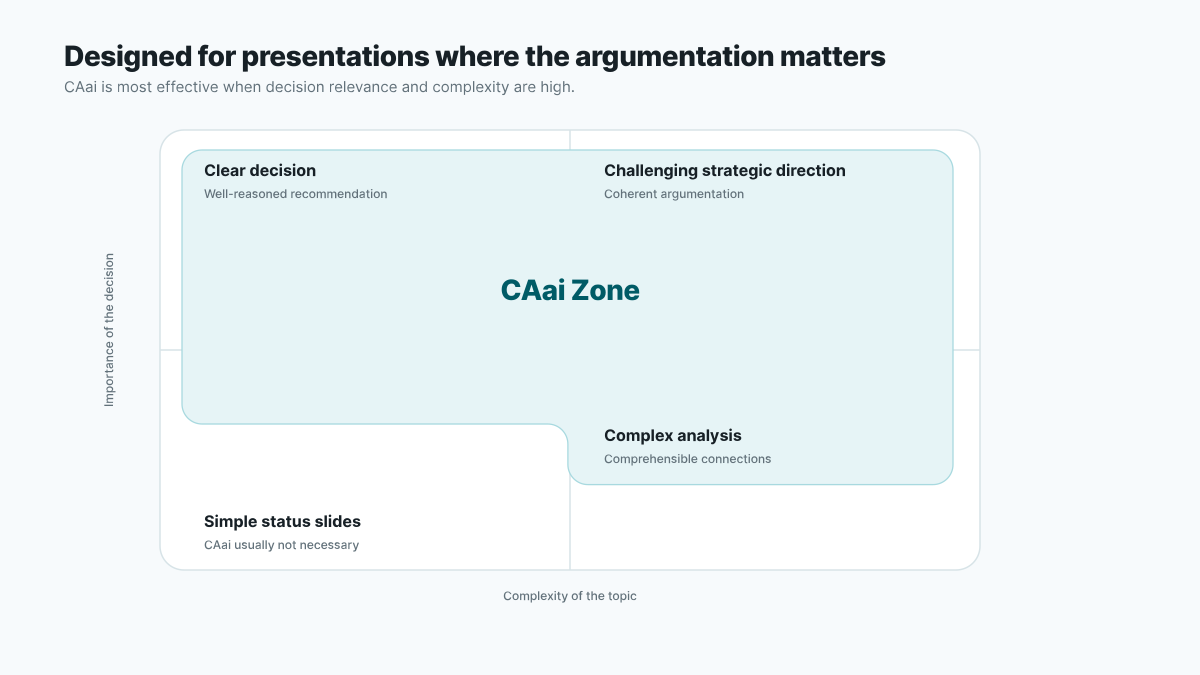
CAai is particularly strong with presentations involving high complexity, multiple stakeholders or real decision relevance.
- Management decisions
- Investments, projects, priorities, reorganizations, resource decisions.
- Project updates with critical points
- Delays, budget risks, scope changes, escalations, new decision needs.
- Sales and pitch presentations
- Complex offers, consulting-intensive services, buying committees, differentiating arguments.
- Internal consulting and strategy work
- Analyses, options, recommendations, transformation programs, change communication.
- Pre-read and committee documents
- Decision foundations that must be understood in advance and later presented convincingly.
- For simple status slides you don't need CAai. For demanding business communication you do.
- Decision-pressure matrix: complexity versus decision relevance
Coordination without version chaos.
Presentations rarely come together alone. Departments provide content, managers sharpen messages, stakeholders comment, decision-makers set priorities. CAai supports this process with shared projects, comments and clear permissions. This way feedback stays bundled – and the argumentation logic is not lost during coordination.
- One shared working version with bundled feedback instead of many PowerPoint files
Designed for professional use in a corporate environment.
CAai is built for business contexts where confidentiality, traceability, corporate design and consistent quality matter.
Without a choice, AI processing stays in Switzerland. On request: European models or the most capable latest-generation models – enabled per company, only with explicit confirmation.
- Swiss hosting
- Operated on Swiss servers.
- Corporate design
- PowerPoint templates can be used; content remains natively editable.
- Multilingual
- German, English, French and Italian – for app and content.
- Traceability
- Recommendations are justified; content can be reviewed, adjusted and approved.
- Pilot-ready
- CAai can be tested in a controlled way with selected users and real presentation cases.
- Selectable AI routes
Test CAai on a case where the argumentation really counts.
CAai is best understood not through a generic demo, but through a real presentation project: a project decision, a management update, a pitch, a strategy recommendation or a committee document. In a demo we show how a clear presentation logic emerges from your topic – with audience perspective, storyline, arguments and concrete outputs.
- info@caai.online
- Test CAai with your own topic
- Discuss a pilot program
- 45 minutes · remote or on site · with a real example from your context
- Go directly to login